Do I Need a Subpanel in My Garage for an EV or Mini‑Split?
Buying a home and planning an EV charger or mini-split? Here’s when a garage subpanel makes sense, how panel location affects cost, and what to check before you move in.
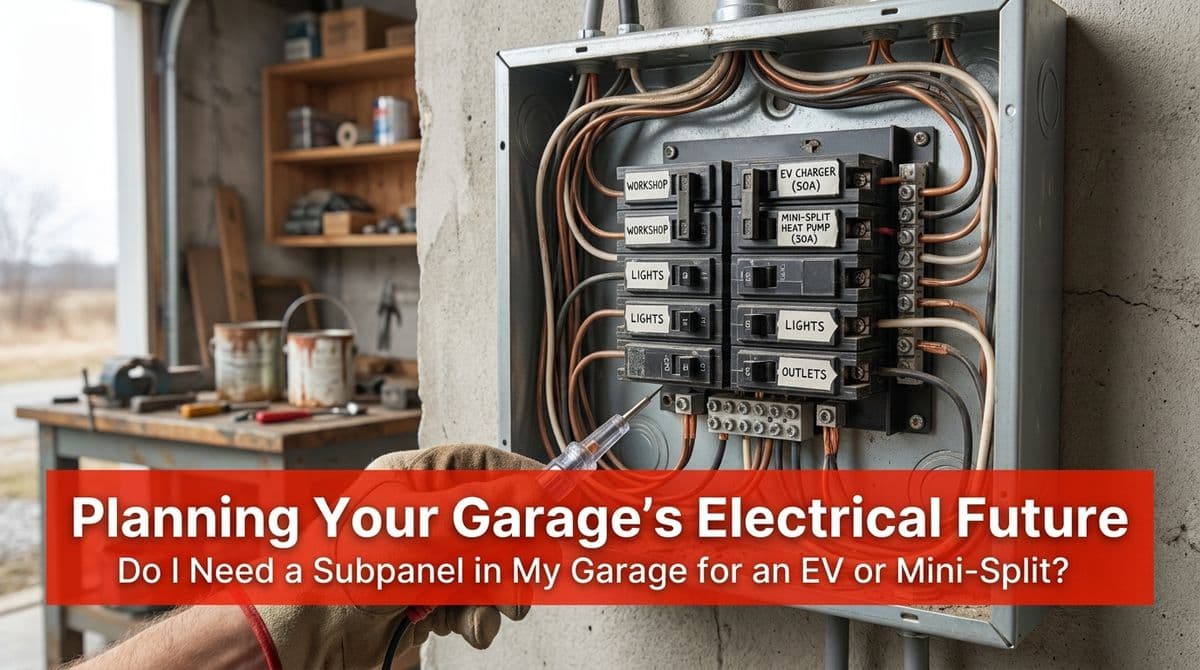
Planning Power for Your New Garage: Do You Really Need a Subpanel?
We recently got a call from a customer — let’s call him Sam— who was in the middle of buying a new home. He’d closed on his last house with a 50-amp circuit we installed for an EV charger, and now he wanted the same setup in his new place.
The twist? In this new house, the main electrical panel was on the opposite side of the garage. Long run, lots of attic, and he was already thinking ahead about an EV charger, a future mini-split for the garage, and “a couple circuits” he knew he’d want down the road.
On the call, I said something I end up saying a lot: “Think about maybe putting a subpanel in your garage, and then from there we can come off with your EV and your mini split.” That one suggestion opened up a whole conversation about cost, future-proofing, and how to know what you’re buying when you’re looking at a home’s panel.
If you’re in a similar situation — new home, new EV, or planning more 240V loads — here’s how we walk homeowners through the decision.
What Exactly Is a Subpanel?
A subpanel is basically a smaller “satellite” electrical panel that feeds off your main service panel. Power comes from a breaker in the main panel, through a feeder cable, into the subpanel, where you have more breaker spaces for additional circuits.
Think of it like this: your main panel is the trunk of the tree, and the subpanel is a big branch that lets you grow a bunch of smaller branches (circuits) right where you need them — like in a garage or workshop.
Key points about subpanels:
They do not increase the total power your utility provides; they just redistribute it.
They give you more breaker spaces close to where you need power.
They can make future projects (EV charger, mini-split, tools) faster and cheaper to install.
When a Garage Subpanel Makes Sense
With Sam, the main issue was distance. The main panel was all the way on the other side of the house, and he already knew he wanted a 50-amp EV circuit in the garage. He was also toying with a mini-split and some extra outlets later on.
That’s a textbook situation where we start talking about a garage subpanel. It usually makes sense when:
The main panel is far from the garage or workshop.
You expect to add multiple new circuits (EV charger, mini-split, dedicated outlet for tools, air compressor, etc.).
Your main panel is already crowded or nearly out of breaker spaces.
You want a clean, organized way to control all garage loads in one spot.
If you only ever plan on one small circuit in the garage, a subpanel can be overkill. But if you’re thinking EV today and a mini-split or more 240V loads in the next few years, planning ahead can save you money and headaches.
How Panel Location and Long Wire Runs Affect Cost
On our call, Sam immediately realized: “Oh, snap. It’s a long run.” He was right to notice — distance is a big part of cost.
Here’s what affects price when your main panel is far from the garage:
Wire length & size: A 50-amp or 60-amp 240V circuit needs thicker copper or aluminum wire. The longer the run, the more expensive the material.
Routing the cable: Running through attic space, drilling through framing, and staying code-compliant all add labor time.
Voltage drop: Very long runs may require upsizing wire to avoid significant voltage drop, which again raises cost.
When you know you’ll eventually want multiple circuits in the garage, doing one long heavy feeder to a subpanel once is often more cost-effective than running several separate long circuits from the main panel over the years.
Buying a Home? How to Check for Available Breaker Space
Sam was smart — he said he’d be at the inspection and would “double check the panel” and send a photo. That’s exactly what we recommend if you’re in escrow on a house and already thinking about upgrades.
Here’s what you can safely look for (without removing any covers):
Open breaker spaces: With the panel door open, look for unused spots that have a removable knockout cover. Those are potential spots for new breakers.
Panel label: Inside the door, there’s usually a label listing maximum breaker count and whether tandem (slim) breakers are allowed in certain slots.
Main breaker size: You’ll often see 100A, 125A, 150A, or 200A on the main. That gives us a quick idea of overall capacity.
Then, take clear photos of:
The whole panel with the door open.
The label inside the panel door.
The surrounding area, so we can see access and routing options.
Send those to your electrician, and we can usually tell you if a subpanel is a good idea, or if we can just add a new breaker or two to the existing panel.
Planning for EV Chargers, Mini‑Splits, and Future 240V Loads
Sam’s immediate need was a 50-amp circuit so his wife could charge and “do the stuff she needs to do” as soon as they moved in. But he was already tossing around the idea of a mini-split in the garage and other circuits later.
When we plan a garage subpanel, we think in terms of future loads. Common 240V garage loads include:
Level 2 EV charger: Often 40–60 amps.
Mini-split heat pump: Typically 15–30 amps depending on size.
Air compressor or welder: Frequently 20–50 amps.
Electric water heater or dryer (if located in garage): 20–30 amps.
We’ll usually recommend a 60–100 amp subpanel in the garage, sized based on what you realistically plan to add over the next 5–10 years, not just what you need this month.
Questions to Ask Yourself Before You Move In
Do I have or plan to buy an EV in the next few years?
Is my garage too hot or cold now — would a mini-split help?
Do I run lots of power tools or plan a serious workshop?
Am I likely to add a second EV or more big 240V equipment?
If you answer “yes” to more than one, a garage subpanel is worth a serious look.
Why Planning Ahead Usually Saves Money
When Sam mentioned he’d “made a little bit of money on our last house” and wanted to do smart upgrades right away, I told him the same thing I’d tell any homeowner: adding a subpanel isn’t a “crazy expensive endeavor” compared to doing several long, separate projects down the line.
By planning for a subpanel early, you:
Limit attic work to one feeder run instead of multiple future trips.
Create flexibility for any electrician to add circuits quickly later.
Keep your main panel organized instead of cramming in tandems where they may not even be allowed.
Future‑proof your garage for the next wave of electric tools, vehicles, and comfort upgrades.
If you’re in the “new house, new projects” phase like Sam, it’s the perfect time to send us panel photos, talk through what you’re planning, and decide whether a garage subpanel is the right move. A little planning now can make your future EV charger, mini-split, and other upgrades a whole lot easier.