Missing Junction Box on Your Attic HVAC? Read This Before Closing
Home inspector flagged a missing junction box on your attic HVAC unit before closing? Here’s why it matters, what it really means, and how to handle it smartly.
Why That “Little Junction Box” in Your Attic Suddenly Matters
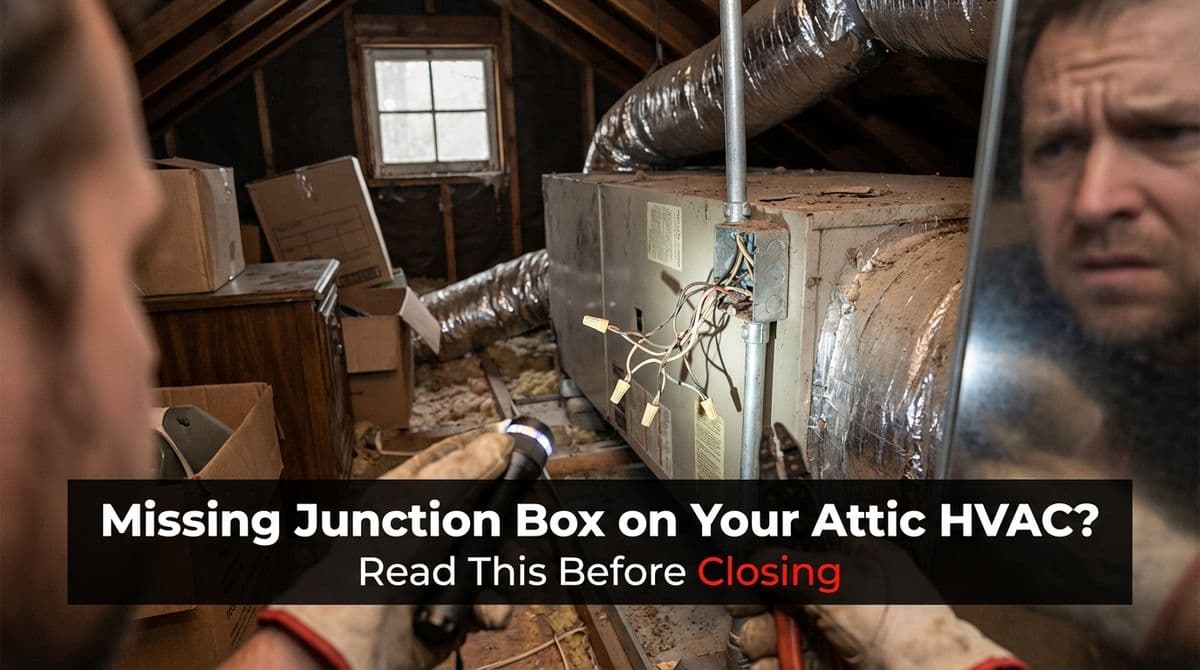
We recently got a call from a homeowner — let’s call him Mark — who had just sold his townhome. During the buyer’s inspection, the home inspector flagged something in the attic on the HVAC unit: a missing junction box where the main electrical line entered the air handler.
On the surface, it sounded minor. Mark told me, “It’s just a little junction box they want added, but the builder’s HVAC company said, ‘We don’t do little junction boxes — you need an electrician.’ We’re moving, we don’t want to spend a lot, we just want to close.”
That situation comes up a lot during real estate deals, especially with attic HVAC units. Let’s walk through why inspectors flag this, what it means for safety and code, and what you as a homeowner should realistically do before closing.
What Inspectors Are Seeing on Your Attic HVAC Unit
When Mark called, he mentioned he had both the inspection report and photos from the inspector. That’s exactly what I asked him to text me so I could see what we were dealing with. I needed to know: is this a simple single circuit coming into the unit, or a box with a dozen splices hanging in midair?
On many attic HVAC units, the main electrical feed (usually in flexible metal conduit or NM cable, depending on the setup) comes over to the air handler or furnace and then disappears into the metal cabinet. The problem inspectors are looking for is this:
- Wires entering the unit without a proper connector or box
- Wire splices (connections) made inside the unit but not enclosed in a junction box
- Cable sheathing stripped back too far and conductors exposed
When they write “missing junction box,” what they usually mean is that the electrical connections feeding the HVAC unit are not contained in an approved, listed enclosure with a cover.
Why the Electrical Code Cares About Junction Boxes
It’s easy to think, “It’s worked like this for years, so what’s the problem?” But the National Electrical Code (NEC) is pretty clear on a few things that apply here:
- All wire splices must be inside an approved junction box with a solid cover.
- Cables entering equipment must be secured with proper connectors to protect the wires from abrasion and strain.
- Boxes must remain accessible — you can’t bury them in a wall or ceiling where you can’t get to them.
Attic HVAC units live in a tough environment: heat, vibration, dust, and people stepping around for maintenance. If the electrical connections aren’t protected in a box, the insulation can get damaged, connections can loosen, and in a worst-case scenario, you’ve created a shock or fire hazard.
That’s why home inspectors will flag it even if the system has “worked fine” for years. They’re looking at safety and code compliance, not just whether the unit turns on.
Why the HVAC Company Didn’t Want to Touch It
In Mark’s case, he had already called the HVAC contractor that installed the system. They came out, took a look, and basically said, “We don’t do little junction boxes — you’ll need an electrician.”
That’s more common than you might think. Here’s why:
- HVAC installers focus on refrigerant, ductwork, and equipment — not full electrical code compliance outside the unit.
- Adding a junction box is considered electrical work, and not every HVAC tech is licensed or insured to perform that.
- Inspectors hold the current seller responsible, not the original builder or trades, so it lands back in your lap during the sale.
That’s usually the point where someone like Mark calls us. They don’t necessarily need a big project, just a safe, code-compliant fix that will satisfy the inspector and the buyer without blowing up the budget right before closing.
What a Proper Junction Box Fix Typically Involves
Every attic setup is a little different, which is why I asked Mark to send photos first. But in many cases, the repair is straightforward for a licensed electrician. It usually looks something like this:
- Turn off power at the breaker to the attic unit.
- Install an approved metal or plastic junction box on a nearby framing member or securely on the unit, if listed and allowed.
- Run the incoming cable or conduit into the new box using a proper connector to protect the wires.
- Make all splices inside the junction box with the correct size wire nuts or connectors.
- Run a short whip or conduit from the junction box to the HVAC unit, again with proper connectors.
- Label the circuit and replace the box cover so everything is enclosed and accessible.
For a simple single-circuit feed with easy access, this is often a relatively quick job. Where it gets more involved (and therefore more expensive) is when there are multiple circuits, tight spaces, or previous “creative” wiring to correct.
What You Should Do as a Homeowner Before Closing
If you’re in the same boat as Mark, here’s a practical game plan to get from inspection report to closing table without unnecessary drama:
1. Get Clear Photos and the Inspector’s Note
Have the inspector’s report handy and take clear photos of:
- The overall HVAC unit in the attic
- The point where the electrical cable or conduit enters the unit
- Any visible wire splices or open connections
Send those to your electrician before they come out. That’s exactly what I asked of Mark so I could tell whether he was looking at a quick fix or something more involved.
2. Ask for a Specific, Written Scope (Not Just “Add a Box”)
When you call an electrician, mention:
- That the item was flagged on a home inspection
- It’s an attic HVAC unit feed with a “missing junction box”
- Whether you’re under contract and on a deadline to close
Ask them to address the exact language from the inspection so the repair lines up with what the buyer’s inspector wants to see on reinspection.
3. Balance Cost, Safety, and Negotiation
Most sellers, like Mark, don’t want to spend big money right before moving. In many cases, the junction box fix is modest compared to other inspection items. But if anything more extensive shows up while we’re there (like undersized wiring or multiple code issues), you’ll have to decide whether to:
- Fix everything now for long-term safety and peace of mind for the buyer, or
- Negotiate a credit or price adjustment with the buyer so they can handle it after closing
Either way, having a licensed electrician’s written estimate or invoice gives you something concrete to work with in negotiations.
When in Doubt, Ask an Electrician to Take a Look
If your home inspector flagged a missing junction box on an attic HVAC unit, it’s not just nitpicking — it’s about protecting live electrical connections in a hot, cramped, hard-to-reach space. Sometimes it really is as simple as adding a small box and doing the connections correctly; other times, we uncover issues that are worth addressing before you hand the keys over.
If you’re under contract and staring at an inspection report that mentions junction boxes, attic units, or “exposed electrical connections,” reach out and let us take a look at photos first. That way we can give you a realistic idea of what’s involved, how quickly we can get it done, and how to make sure the buyer’s inspector is satisfied on the first recheck.