Why Your New Oven or Microwave Keeps Tripping or Dying
New oven or microwave keeps tripping or losing power in a newer home? Here’s what might be wrong with the wiring, breaker, or grounding behind your built-in.
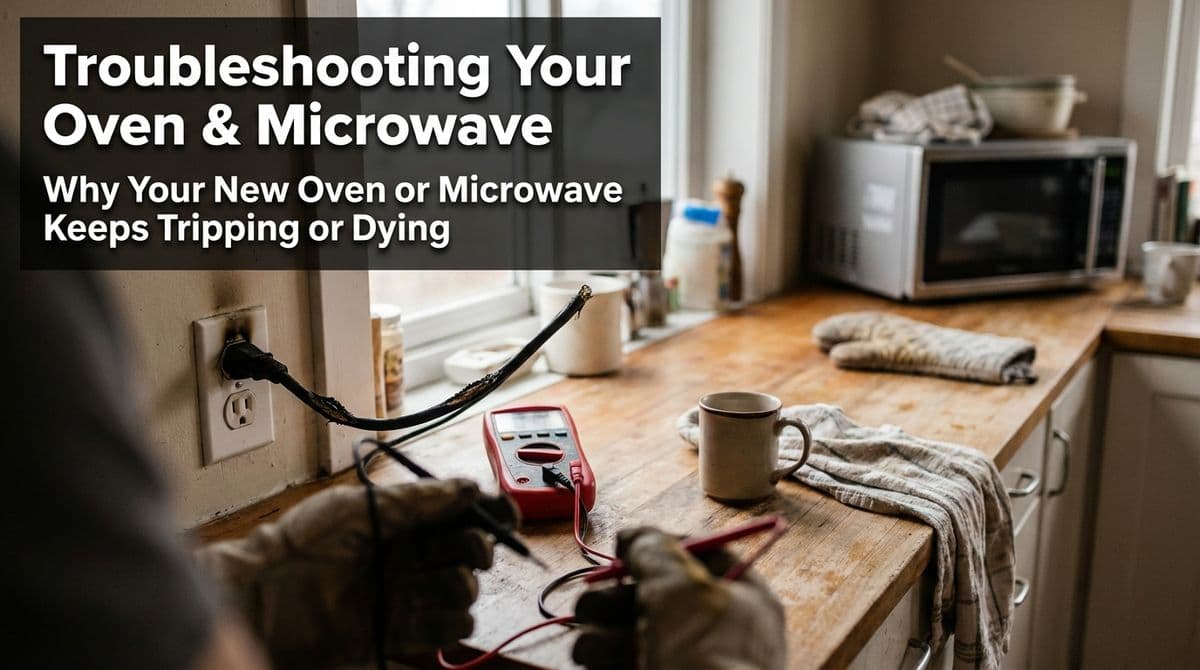
When Your “Brand-New” Kitchen Keeps Losing Power
We recently got a call from a homeowner — let’s call him Ryan — who was beyond frustrated with his shiny, three-year-old kitchen.
His built-in oven and microwave combo had gone out. The appliance company came, replaced parts, and got everything “working”… only to tell him, “This is actually an electrical problem. You need an electrician.”
Ryan told us the tech mentioned things like grounding, wiring, and not getting the proper amps. At one point, the tech even got a pretty good shock testing the wires behind the cabinet. Not exactly confidence-inspiring in a relatively new home.
If that story feels a little too familiar, you’re not alone. We see this a lot in newer builds with built-in kitchen appliances. Let’s walk through what might really be going on when your “new” oven or microwave keeps tripping or losing power.
Appliance vs. Electrical: Who’s Actually to Blame?
One of the first things Ryan said to us was, “They replaced all the parts. Now they say it’s power behind the unit.” That’s a common pattern:
- Appliance acts up (shuts off, trips breaker, won’t heat consistently).
- Appliance company replaces boards, elements, or internal wiring.
- Problem either keeps coming back or they discover unsafe power issues at the wall.
In many newer homes, the appliances themselves are fine. The electrical supply feeding them isn’t. That can show up as:
- Breaker tripping when the oven preheats or the microwave runs.
- Display going blank and coming back on randomly.
- Microwave working, oven not — or vice versa — on a combo unit.
- A service tech reporting “I’m reading too many amps” or “I got shocked behind the cabinet.”
Common Electrical Issues Behind Built-In Ovens & Microwaves
When we come out to troubleshoot situations like Ryan’s, we’re usually looking for a few usual suspects.
1. Undersized or Incorrect Wiring
Your oven or oven/microwave combo has a nameplate rating on it — usually in the door jamb or on the back — that tells us how many amps it requires. The wiring and breaker must match that requirement.
On some new builds, we find:
- Wire that’s too small for the appliance load.
- Cable type that’s not appropriate for the circuit.
- Shared circuits that shouldn’t be shared.
When a wire is undersized, it can overheat or cause nuisance tripping. Long term, it’s not just an inconvenience — it’s a safety issue.
2. Loose or Poor Connections
Behind built-in cabinets, everything is crammed into a tight space. We sometimes find:
- Loose wire nuts or terminal screws.
- Back-stabbed connections in boxes instead of properly tightened screw terminals.
- Extension cords or “temporary” solutions left in place behind cabinets.
Loose connections can arc (tiny sparks), generate heat, and cause intermittent power — and yes, they can absolutely give a tech a shock when they reach back there.
3. Grounding and Bonding Problems
Ryan was told there was a grounding issue. Proper grounding is what helps keep you safe if something goes wrong. When the ground is missing or improperly connected, metal parts of the oven or microwave can become energized.
Warning signs of grounding or bonding issues include:
- Service techs reporting shocks when testing or touching metal.
- Buzzing or humming from the appliance when it shouldn’t be running.
- Odd readings when we test voltage between hot, neutral, and ground.
4. Wrong Type or Size of Breaker
In Ryan’s case, the appliance tech said the breaker seemed fine, but that’s not always true for every home. Some common breaker problems:
- Standard breaker where a double-pole or GFCI/AFCI combo is required by current code.
- Incorrect amperage — too high (unsafe) or too low (constant tripping).
- Shared breakers feeding multiple high-draw kitchen appliances.
Part of our job is comparing the appliance’s nameplate rating to the breaker and wire size and making sure all three match.
What We Actually Do on a Service Call Like This
When we scheduled Ryan, he asked, “What does troubleshooting even look like?” Here’s the basic process we walk through:
- Visual inspection of the oven/microwave connection, junction box, and surrounding cabinetry.
- Turn off power at the panel and safely pull the unit out (if accessible).
- Check the wiring type, size, and condition feeding the appliance.
- Verify connections are tight, properly grounded, and not showing signs of heat or arcing.
- Match the nameplate rating to breaker size and wire gauge.
- Restore power and test under actual load (preheating the oven, running the microwave, etc.).
Sometimes we find a simple fix — a loose connection, an improperly landed neutral, or a small wiring error. As we like to say, “Simple fixes are the best.” Other times, it’s more involved.
When You Might Need a New Circuit Pulled
Worst-case scenario, and what we warned Ryan about, is that the existing circuit is just wrong for the appliance. That can mean:
- The wire is too small or damaged.
- The run is too long and voltage drop is excessive.
- The circuit is shared with other loads it was never meant to handle.
In those cases, the real fix is to pull a new, dedicated circuit from the electrical panel to the oven/microwave location using correctly sized wire and a properly rated breaker. It sounds like a big job, but it’s far better than living with a potential fire hazard behind your cabinets.
What You Can Check as a Homeowner (Safely)
There are a few things you can do on your own without opening panels or handling live wires:
- Find the breaker that controls your oven/microwave and see what amperage it’s labeled (e.g., 30A, 40A, 50A).
- Locate the appliance’s nameplate rating (often inside the door) and note the volts/amps or watts.
- Note any patterns — Does it trip only when the oven and microwave run together? When other kitchen circuits are in use?
- Listen and look for burning smells, discoloration, or heat around the cabinet or wall — if you notice any of these, shut it off and call immediately.
What you shouldn’t do is start pulling appliances out and poking around wiring if you’re not trained. If a professional tech already got a shock back there, it’s not the place to experiment.
Out of Warranty Doesn’t Mean You’re Out of Options
Ryan’s builder told him, “You’re out of warranty, there’s nothing we can do.” That’s unfortunately common. But being out of builder warranty doesn’t mean you have to live with unsafe or unreliable electrical.
If your newer home’s built-in oven, microwave, or combo unit is tripping breakers, losing power, or making service techs nervous, it’s worth a proper electrical inspection. We can make sure the wiring, breaker, and grounding all match what your appliance actually needs — and that you’re not cooking dinner on borrowed time.
Need help sorting out a stubborn oven or microwave issue? We’re happy to come out, troubleshoot from the panel to the appliance, and let you know whether it’s a simple fix or a circuit that needs to be done right.