Planning EV Charger & Hot Tub Electrical Upgrades
Thinking about an EV charger and a hot tub? Learn how panel location and wiring routes affect cost, appearance, and installation options.
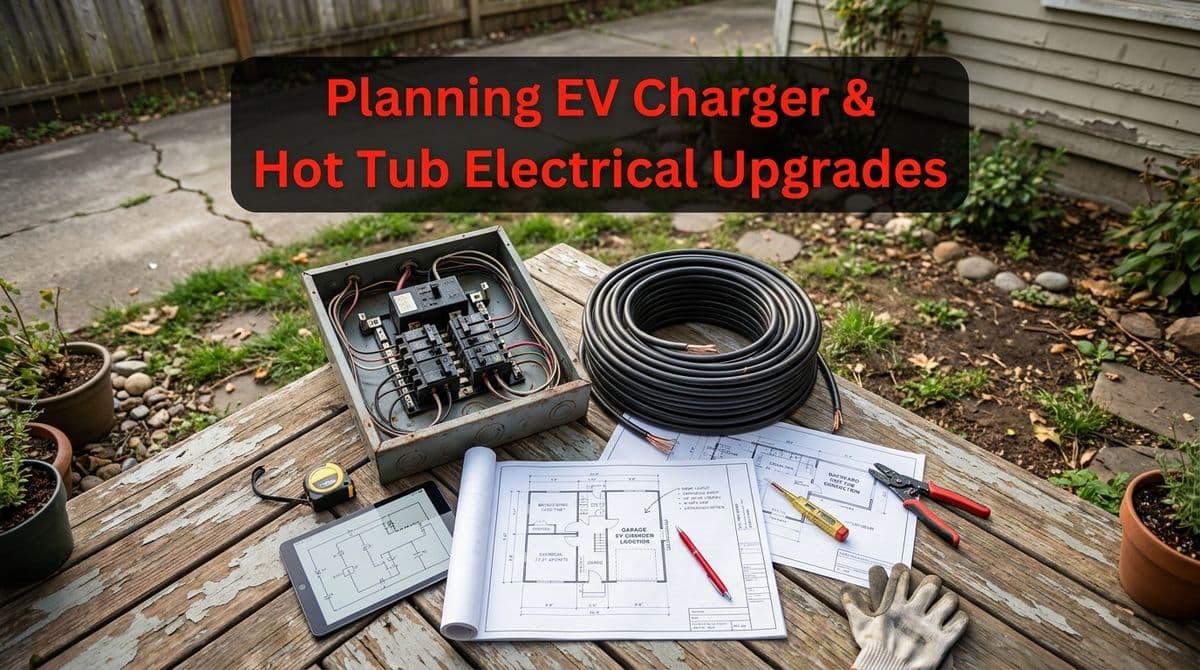
Planning Electrical Upgrades for EV Chargers and Hot Tubs
We recently got a call from a homeowner — let’s call him Brian — who was excited about two big upgrades: adding an EV charger in his garage and running power to a new hot tub in the backyard.
Brian’s question was simple: “Can you give me a price for both?” But once we started talking, we quickly got into the details that really matter — panel location, wiring routes, attic space, and how all of that affects cost, appearance, and installation options.
If you’re thinking about an EV charger and a hot tub, your situation might be very similar to Brian’s, so I’ll walk you through how we look at a project like this and what you should know before you get quotes.
Why Panel Location Matters So Much
The first thing we asked Brian was, “Where’s your electrical panel in relation to your garage?” In his case, the garage was on one side of the driveway and the panel was on the opposite side of the house. That instantly told us the EV charger circuit would be a longer run.
Here’s why panel location is so important:
- Longer runs = more wire — Copper wire isn’t cheap, and EV chargers and hot tubs both need larger gauge wire for higher amperage circuits.
- More labor — The farther we have to go, the more time it takes to fish wire through walls, attic spaces, or conduit.
- Routing limitations — We have to follow safe, code-compliant paths, which may not always be the most direct line.
With a typical home where the panel and garage are on opposite sides, we often see around 60–80 feet of cable just to get from the panel to the charger location. That’s exactly what we anticipated for Brian’s project.
Using Attic Space vs. Surface Conduit
Once we know where the panel is, the next big question we ask is the one we asked Brian: “Do you have usable attic space, or are your ceilings finished with no access?”
Attic space gives us more options:
- Cleaner look — We can usually run cable through the attic, then drop down inside the wall near the garage where the EV charger will mount.
- Better protection — Wiring is hidden and protected from weather and physical damage.
- Flexible routing — We can often get around obstacles more easily from above.
If there’s no attic access or the layout is tricky, we may need to use surface-mounted conduit on the exterior of the home or along the garage wall. That’s perfectly safe and code-compliant when installed correctly; it just has a more “industrial” look that some homeowners like and others prefer to avoid.
Planning the EV Charger Location in the Garage
With Brian, we talked about where he actually parks and where he wants the EV connector to land. A few feet of difference can matter when we’re planning the wiring route.
When you’re thinking about your own EV charger, consider:
- Which bay you’ll park in most often
- Where the EV’s charge port is (front, rear, driver’s side, passenger side)
- Cable reach — You want to be able to plug in without stretching the cord across walkways
We usually recommend mounting the EV charger on the wall closest to where the charge port will be most of the time, while still giving us a practical route from the main panel or subpanel.
Hot Tub Wiring: Straight Shot vs. Creative Routing
For Brian’s hot tub, the setup was actually a bit easier. The tub was planned for the backyard on roughly the same side of the house as the electrical panel, with a fairly straight shot from the panel back to the yard.
We walked through several routing options with him, which are similar to what we look at on most hot tub projects:
- Through the attic, then down into the wall and out near the tub area
- Along the exterior wall in conduit near ground level, painted to match the home
- Up high under the eaves in conduit, then down near the tub location
- Partially underground in conduit if we need to cross open areas or protect the run
The right choice depends on where the hot tub sits, what you’ll see from your patio or windows, and whether this is your “forever home” or a shorter-term stay. In Brian’s words, the EV charger run was the “farther run,” while the hot tub line was a shorter, more direct route.
Underground vs. Above-Ground Conduit for the Backyard
Many homeowners, like Brian, ask if we go underground or “right at ground level” with conduit. Both are possible, but they each have pros and cons:
Underground Conduit
- Pros: Hidden from view, protected from physical damage, very clean look in the yard.
- Cons: Requires trenching, more labor, may need landscaping touch-up afterward.
Low or High Surface Conduit
- Pros: Less invasive, faster to install, easier to modify later.
- Cons: Visible on the exterior; must be mounted neatly to look good.
For a “forever home,” many people choose the cleaner, more permanent-looking option, even if it means a bit more work up front. For shorter-term plans, a simpler surface route might make more sense.
Key Questions to Answer Before You Get Quotes
If you’re getting ready to call an electrician about an EV charger and hot tub, here are a few things to have in mind:
- Where is your main electrical panel located?
- Is there attic access above the panel and garage?
- Where, exactly, will the EV charger be mounted?
- Where will the hot tub sit in the yard?
- Do you have any preferences about visibility of conduit or surface wiring?
Having these answers ready helps us give you a much more accurate estimate, just like it did with Brian, and lets us design a solution that’s safe, code-compliant, and looks good on your home.
If you’re planning an EV charger, a hot tub, or both, we’re happy to walk through these details with you and design the best wiring routes for your home.